Capstone Classics

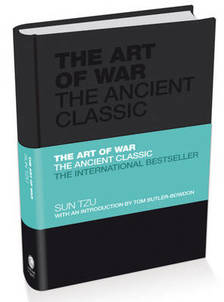
Art of War cover

The Art of War

(6th century BC)

Sun Tzu

That a person of today, a civilian, would want to read a manual for waging war that is over two thousand years old, must say something about that work’s enduring power.

But what, exactly, can the modern reader get from The Art of War?

In the capitalist knowledge society that we live in, in which individual qualities are quickly exposed, its emphasis on the importance of personal character and knowledge as the keys to success has never been more relevant. For its author, Sun Tzu, insisted that the wise general or leader could not simply rely on their knowledge of the terrain or the capabilities of the opposition, but had to know themselves. To become invincible, one first had to develop deep understanding, and full control, of one’s own reactions, to be the same in the face of praise or blame. Victory, Sun Tzu said, comes to those who have developed an ethic of constant refinement and improvement. It is never possible to control the other, but by developing our own strength of character, knowledge and insight we can build invincibility.

The Art of War provides a whole philosophy for action that applies to life as much as battle. 

“In war there is no fixity”, Sun Tzu says. The wise general does not simply come up with a plan and rigidly follow it, but is attuned to the ‘Tao’ of a situation, or the particular way events are moving at any one moment in time. Such a leader can act objectively and with perfect timing.

Being a great leader: The five factors

Sun Tzu identified ‘five indispensable matters’ which had to inform a leader’s decisions: The Way; Heaven; Earth; Leader; and Law. What do these actually mean, and how can we apply them in our own context?

In Sun Tzu’s army, The Way refers to the extent to which there is singularity of purpose, with leader and soldiers tightly bound to the same goals. There is very little such a body of people cannot accomplish, since they move with the power and purpose of one. The obvious lesson for organizations of any place or time: do not waste energy on internal divisions, and move ahead united.

Related to the individual, The Way involves the five virtues of humanity, righteousness, propriety, wisdom and faith, suggesting a mature person who, having developed themselves over many years, is ‘all of a piece’ and galvanized by clear goals.

Heaven and Earth, as Sun Tzu uses the terms, are the conditions within which a general wages war. In a modern context, this can be interpreted as heightened, present-moment awareness of the social, political and economic environment in which one lives and works. Such awareness allows one to make the most of opportunities, avoid dangers and develop intuition about what is to come.

Leader means a person or an organization that exhibits timeless values. The combination of ‘hard’ and ‘soft’ attributes - Sun Tzu specifically refers to sincerity, wisdom, benevolence, courage and strictness as qualities of the great general - marks out an individual as deeply humane, and yet someone who means business. An organization, similarly, must be seen to be tightly focused on its mission, and yet always be acting ethically.

Law in Sun Tzu’s terms refers to ‘the ordering and partition of troops’. For ourselves, we can take it to mean having one’s house in order and establishing priorities. In an organization, Law may mean the appointment of the right people, who know exactly what they are accountable for and who have the resources to execute their mission.

Of these five factors of action, Sun Tzu says, “to know them is to conquer; to know them not is to be defeated.”

* * *

This above is just an excerpt from my Introduction to the new Capstone edition of The Art of War.

As one of the great writings in leadership and conflict resolution, I believe The Art of War has a place in every personal development and business library.

Click on the links below to buy or for more information.

Applying Sun Tzu's timeless lessons, you too can be a great leader!


More details

The Art of War: The Ancient Classic

Sun Tzu, with an Introduction by Tom Butler-Bowdon

Capstone (Wiley), 2010

220 pages, hardback

ISBN 978-0857080097


Buy online

Amazon UK

Amazon.com


Wattles Science of Getting Rich Cover

Think and Grow Rich Cover

Wealth of Nations cover

The Prince Machiavelli cover

Butler-Bowdon.com ©2012 All rights reserved.