|
Motivation and Personality
(1954) Abraham Maslow In the summer of 1962, Abraham Maslow was driving through heavy fog on the treacherous Big Sur coastal highway in California. Noticing an interesting sign, he decided to pull over. The place he had stumbled upon turned out to be the world's first personal growth center, Esalen, where, serendipitously, staff inside were unpacking copies of his latest book, Towards A Psychology of Being. With such a beginning, it was perhaps inevitable that Maslow would become the high priest of the 1960s human potential movement. Through the core idea of the 'self-actualizing person', his Motivation and Personality had presented a new image of human nature which excited a whole generation. Yet Maslow was not an obvious revolutionary. As an academic psychologist his work was essentially a reaction against behaviorism, which broke people down to mechanistic parts, and Freudian psychoanalysis, which imagined us controlled by subterranean urges. Still working within the boundaries of the scientific method, Motivation and Personality instead sought to form a holistic view of people, one not dissimilar to how artists and poets have always imagined us. Rather than being simply the sum of our needs and impulses, Maslow saw us as whole people with limitless room for growth. It was this clear belief in human possibility and the organizations and cultures we could build that has made his work so influential. The key concepts: hierarchy of needs and self-actualization Maslow's 'hierarchy of needs' is a famous concept in psychology. He organized human need into three broad levels: first, the physiological - air, food and water; then the psychological - safety, love, self-esteem; and finally, self-actualization. His insight was that the higher needs were as much a part of our nature as the lower, indeed were instinctive and biological. Most civilizations had mistakenly put the higher and lower needs at odds with each other, seeing the animalistic basic drives as conflicting with the finer things to which we aspire like truth, love and beauty. But Maslow saw needs as a continuum, in which the satisfaction of the lower needs came before a person's higher mental and moral development. Having met the basic bodily requirements, and having reached a state where we feel we are loved, respected and enjoy a sense of belonging including philosophical or religious identity, we seek self-actualization. Self-actualizing people have attained '...the full use and exploitation of talents, capacities, potentialities and the like'. These are the people who are a success as a person, aside from any obvious external success; by no means perfect, but seemingly without major flaws. Since Daniel Goleman wrote his bestseller on emotional intelligence, people have 'discovered' it as being a key to success, yet for self-actualized people this type of intelligence is ingrained. Maslow's research involved the study of seven contemporaries and nine historical figures: Abraham Lincoln, Jefferson, Einstein, Eleanor Roosevelt, Jane Addams, William James, Albert Schweitzer, Aldous Huxley and Spinoza. He identified 19 characteristics of the self-actualized person, including:
A further subtle difference sets these people apart. Most of us see life as a striving to get this or that, whether it be material things or having a family or doing well career-wise. Psychologists call this 'deficiency motivation'. Self-actualizers, in contrast, do not strive as much as develop. They are only ambitious to the extent of being able to express themselves more fully and perfectly, delighting in what they are able to do. Another general point is their profound freedom of mind. Despite the circumstances they may have been in, and in contrast to the conforming pressures all around them, self-actualizers are walking examples of free will, the quintessential human quality. They fully grasp what Stephen Covey calls the gap between stimulus and response, that no response should be automatic. In contrast, the merely 'well-adjusted' (that is, free of neurosis) person may not really know who they are or have a defined purpose in life. As Theodore Rozsak saw it in Person/Planet (1977: 45): "Maslow asked the key question in posing self-actualization as the proper objective of therapy: Why do we set our standard of sanity so cautiously low? Can we imagine no better model than the dutiful consumer, the well-adjusted breadwinner? Why not the saint, the sage, the artist? Why not all that is highest and finest in our species." Maslow made the intriguing observation that, although his self-actualizers shared the above traits and therefore could be grouped as a type, they were more completely individualized than any control group ever described. This is the paradox of the self-actualized: the more of these traits a person has, the more likely they are to be truly unique. Final word Maslow's greatness was in re-imagining what a human being could be. Moving us away from the idea of mental health as merely 'the absence of neurosis', he insisted that psychological health required the presence of self-actualizing traits. Such a fundamental recasting of psychology has had implications for all areas of human activity. At the time he wrote Motivation and Personality, Maslow believed that only a tiny percentage of the population was self-actualized, but that these few could change the whole culture. Given the impact of the idea on the 1960s counter-culturalists, a generation that has changed the world in its image, you would have to say Maslow was right. Certainly, Maslow's hierarchy of needs has been seminal to understanding motivation in the workplace, and the self-actualization of the employee has become a serious concern in business. He foresaw the trend towards personal growth and excitement replacing money as the highest motivator in a person's working life. The principle clearly sets higher standards for individuals and society, and the main criticism of Maslow has been that he is Utopian, creating an ideal human nature that does not exist. And Maslow died before he could address the problem some say he ignored: evil. The desire for self-actualization may be a factor in the spread of democracy and the growth in recognition of human rights, but what light does it shine on horrors like Rwanda and Kosovo? If self-actualization is a facet of human nature, then its absence creates a vacuum filled by repression, poverty and nationalism, making the world ripe for evil. Seen this way, the fulfillment of the self should never be thought of as luxury. The evolution of the species, in fact, depends on it. |
“On the whole I think it fair to say that human history is a record of the ways in which human nature has been sold short. The highest possibilities of human nature have practically always been underrated.” Abraham Maslow Born in 1908 to Russian-Jewish immigrants in Brooklyn, New York, Maslow was the first-born of seven children. He was said to be shy, neurotic and depressive, but with a passionate curiosity and incredible native intelligence (an IQ of 195), he excelled in school. At college, Maslow's early influences were Harry Harlow, the distinguished primate researcher, and the behaviorist Edward Thorndike. While at Columbia University, Maslow's research into the sex lives of college women attracted controversy. During his 14-year professorship at Brooklyn College, his mentors included Alfred Adler, Karen Horney, Eric Fromm and Margaret Mead. The anthropologist Ruth Benedict and founder of Gestalt therapy, Max Wertheimer, became friends and models for the idea of the self-actualizing person. In 1951 the author moved to Brandeis University, where he stayed until a year before his death in 1970, and where Motivation and Personality was written. With Rollo May and Carl Rogers, Maslow founded the 'third force' humanistic branch of psychology, and its extension, transpersonal psychology, which went beyond the regular needs and interests of the person to their spiritual and cosmological context. In 1962 Maslow held a visiting fellowship at Non-Linear Systems, a Californian hi-tech company, which resulted in his adaptation of the self-actualization concept to the business setting. The experience led to Eupsychian Management: A Journal (1965). Towards A Psychology of Being was published in 1962, and the classic The Farther Reaches of Human Nature a year after Maslow's death. |
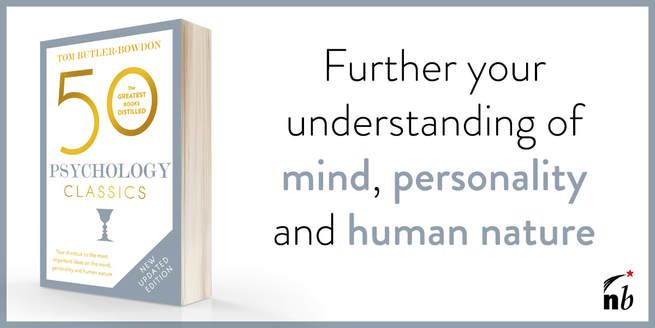
Source: 50 Psychology Classics: Your shortcut to the most important ideas on the mind, personality, and human nature by Tom Butler-Bowdon (London & Boston: Nicholas Brealey)
Click to see reader views or to buy