|
On Becoming a Leader
(1989) Warren Bennis Bennis was a major figure in the academic study of leadership, but also popularized the subject through bestsellers. In 1985 he co-authored Leaders, based on observation and interviews with 90 of America's leaders, ranging from astronaut Neil Armstrong to McDonald's founder Ray Kroc. The book's conclusion was that leadership is more crucial than we know, yet can be learned by anyone. While Leaders is a business classic which analyses the nature of leadership, On Becoming a Leader is about how we can make leadership a personal habit. It arose out of more in-depth dialogue with a smaller number of people including director Sydney Pollack, feminist author Betty Friedan, and musician and A&M records founder Herb Alpert. What is a leader? The book provides many fine insights. Perhaps the key one is that true leaders are not interested in proving themselves; they want above all to be able to express themselves fully. Proving oneself implies a limited or static view of the self, whereas the leader, by continually seeking his or her fullest expression, must be willing to engage in periodic reinvention. For Bennis's leaders, life is not a competition, but a flowering. Structured education and society often get in the way of leadership. Real learning is the process of remembering what is important to us, and becoming a leader is therefore the act of becoming more and more yourself. Leadership is an engagement with life itself, because it demands that your unique vision be accomplished, and that usually involves a whole life. When people protest that they can't lead, or don't want to lead, they are usually thinking of management and giving speeches. But leadership is as varied as people, and the main question is not whether you will be burdened, but how you are challenged to escape mediocrity and conformity and really lead yourself. Becoming a leader involves:
What does the last point mean? Bennis believes that late 20th century business life was mostly about managing rather than leading, with people and organizations focusing on small matters and short-term results. His message is, stop being a product of your context, of your particular place and time. We can see our context as the backdrop for our particular genius to develop, or we can let it enslave our minds. In many ways the path of a `driven' person is an easy one, since it does not require much thought. The leader's path is consciously taken, may be more challenging, but has infinitely greater potential and satisfaction, not to mention better health. To lead, we have to make a declaration of independence against the estimation of others, the culture, the age. We have to decide to live in the world, but outside existing conceptions of it. Leaders do not just 'do well' by the terms of their culture; they create new contexts, new things, new ways of doing and being. Some examples Personal integrity, a compelling vision and the ability to enjoy risk and uncertainty define leadership. Bennis uses the example of television writer/producer Norman Lear, who revolutionized American television by making shows such as All in the Family and Cagney and Lacey. For the first time, TV shows reflected real American people rather than cowboys, private eyes and caricatured families. Lear saw a world that was waiting to be expressed, and expressed it. Not only did his shows break the mold, they were successful year after year. In his assessment of American presidents, Bennis sees Johnson, Nixon and Carter as driven men who projected their personal histories onto the country they ruled. Roosevelt, Truman, Eisenhower and Kennedy, on the other hand, had the gift of personal reinvention and lived in the present to reshape the United States' future. Lincoln was perhaps the greatest president because he focused on what at the time seemed only small possibilities: ending slavery and preserving the Union. His deep personal depressions were nothing put next to those mighty causes. A world of leaders Bennis' conviction is that we badly need leaders. He wrote On Becoming a Leader when American economic leadership was being seriously challenged - we forget now, but in the late 1980s, it did seem for a while that Japan was surpassing the US in production, wealth and innovation. It only regained the ascendancy through obsession with innovation and quality and the realization that firms get ahead by assisting their employees to be all they can be. It took someone of the stature of Bennis to highlight the link between self-knowledge and business success, but this is now almost accepted. The new type of leader is not satisfied with 'doing a job' or 'running a company', but is compelled to find an outlet for his or her personal vision of the world. Now, the only way many companies can attract and keep the best people is by offering them more than just money or prestige - they offer them the chance to make history. Consider, for instance, the internal motto of Internet retailer Amazon.com: 'Work hard, play hard, change the world.' Final word Bennis has probably done as much as anyone to shatter the myth of leaders as heroes, born not made. We live in a democracy of leadership now, in which everyone can lead in some way. As more people understand what leadership means and are taught to achieve their potential, it might be expected that competition will increase to ridiculous levels. But whereas competition is the result of everyone striving to win at the same thing, personal visions are unique. To become a leader is to claim the power and assurance that comes from being a one-off. |
"Leaders have no interest in proving themselves, but an abiding interest in expressing themselves." "What is true for leaders is, for better or worse, true for each of us. Only when we know what we're made of and what we want to make of it can we begin our lives - and we must do it despite an unwitting conspiracy of people and events against us." Warren Bennis Bennis was the youngest infantry commander in the European theatre in World War II. Back home at Antioch College, he found a mentor in Douglas McGregor, the path-breaking management theorist, and was also influenced by Abraham Maslow (see Motivation and Personality). After studying group dynamics, he wrote about new organizational forms, coining the term 'adhocracies' as the opposite to bureaucracies. He gained his Ph.D in economics and social science at Massachusetts Institute of Technology (MIT). Bennis spent several years as president of the University of Cincinnati and executive vice-president at the State University of New York, and was on the faculty of MIT's Sloan School of Management, Harvard and Boston Universities, INSEAD and the Indian Institute of Management in Calcutta. He authored or co-authored 20 books, including the autobiographical An Invented Life (1993), Organizing Genius (1997) and Co-Leaders: the Power of Great Partnerships (1999) with David Heenana. Bennis died in 2014. His last post was at University of Southern California in Los Angeles, as founder and Distinguished Professor of the Leadership Institute, Marshall School of Business. Bennis served on a multitude of high-level advisory boards, including the White House Task Force on Science Policy. On Becoming a Leader was been praised by Al Gore, and has been published in 13 languages. |
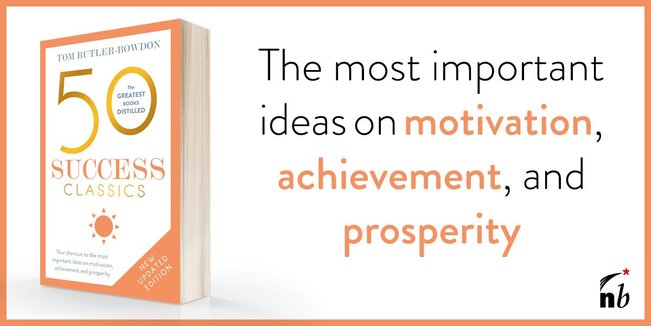
Source: 50 Success Classics: Your Shortcut to the Most Important Ideas on Motivation, Achievement, and Prosperity (published by Nicholas Brealey/Hachette, London & Boston).
Click for reader reviews