|
The 7 Habits of Highly Effective People
(1989) Stephen R Covey Stephen Covey's book is one of the phenomena of modern personal development writing. With reputed sales of over 15 million copies and translations into 32 languages, it also forms the intellectual basis of a large company, Franklin Covey. What lifted it above the mass of books that claim the secret to a better existence? Inside-out success Firstly, it was timing. The 7 Habits of Highly Effective People came out just as we entered the 1990s. Suddenly, aspiring to be a 'Master of the Universe' in a shoulder-padded world did not seem to satisfy, and people were ready for a different prescription for getting what they really wanted out of life. Covey's message of 'restoring the character ethic' was so old-fashioned it seemed revolutionary. Having previously studied the success literature of the last 200 years for a doctoral dissertation, Covey was able to draw a distinction between what he termed the 'personality ethic' - the quick-fix solutions and human relations techniques which had pervaded much of the writing this century - and the character ethic, which revolved around unchanging personal principles. Covey believed that outward success was not success at all if it was not the manifestation of inner mastery; in his terminology, 'private victory' must precede 'public victory'. A business plan for personal life The second, more practical reason for the book's success is that it is a compelling read both as a self-help book and a leadership/management manual. This crossover status effectively doubled its market. It also means that the reader interested only in personal development may not like the management terms, diagrams and business anecdotes that fill it. For a book that is so much about changing paradigms, it is remarkably representative of the paradigm of business thinking. But that should be a small price to pay for what is a brilliant life re-engineering guide, enlivened by Covey's personal and family experiences. Covey may be Dale Carnegie's heir in many ways, but his classic is more systematic, comprehensive and life-expanding than any of the modern self-help titles which came before it. Habits: the building blocks of change The emphasis on habits as the basic units of change has also been important in the book's success. Covey saw that real greatness was the result of slow development of character over time; it is our daily habits of thinking and acting that are the ground on which that greatness is built.The 7 Habits promises a life revolution, not as a big bang, but as the cumulative result of thousands of small, evolutionary changes. The English novelist Charles Reade summarized what Covey is referring to: Sow a thought, and you reap an action; sow and action, and you reap a habit; sow a habit, and you reap a character; sow a character, and you reap a destiny. Effective vs. efficient Finally, the success of the book owes much to the use of 'effective' in the title. By the late 1980s, Western culture had had decades of management theory about efficiency. The concept of time management, product of a machine-obsessed culture, had spilled over into the personal domain, and we could have been forgiven for thinking that any problems in our lives were the result of 'inefficient allocation of resources'. But Covey was hearing the beat of a different drummer, and he came to us with this message: think about what's most important to you and see if it is the centre around which your life revolves. Don't worry about efficiency. There is no use being 'efficient' if what you are doing lacks meaning or an essential good. The 7 Habits puts effectiveness at a higher level than achievement. Achievement is hollow unless what you achieve is actually worthwhile, both in terms of your highest aims and service to others. Covey's view is that the personality ethic of 20th century self-help had helped to create a high-achieving society that also did not happen to know where it was going. The habit of responsibility The seven habits are predicated upon a willingness to see the world anew, to have the courage to take life seriously. The book struck a nerve because it showed many of us, perhaps for the first time, what genuine responsibility was about. To blame 'the economy' or 'my terrible employer' or 'my family' for my troubles was useless. To have fulfilment and personal power, we had to decide what we would take responsibility for, what was in our 'circle of concern'. Only by working on ourselves could we hope to expand our 'circle of influence'. To briefly review the seven habits: 1) Be proactive - We always have the freedom to choose our reactions to stimuli, even if everything else is taken away. With that ability also comes the knowledge we do not have to live by the scripts that family or society has given us. Instead of 'being lived', we accept full responsibility for our life the way conscience tells us it was meant to be lived. We are no longer a reactive machine but a proactive person. 2) Begin with the end in mind - What do I want people to say about me at my funeral? By writing our own eulogy or creating a personal mission statement, we create the ultimate objective or person first, and work backward from there. We have a self-guidance system that gives the wisdom to choose rightly, so that whatever we do today is in line with the image created of ourselves at the end. 3) Put first things first - Habit 3 puts into daily action the far-sightedness of habit 2. Having that ultimate picture in our mind, we can plan our days for maximum effectiveness and enjoyment. Our time is spent with the people and the things that really matter. 4) Think Win/Win - One person's success doesn't need to be achieved at the expense of the success of others. In seeking Win/Win, we never endanger our own principles; the result is a better relationship - 'not your way or my way, a better way' - created by truly seeing from the other person's perspective. 5) Seek to understand, then to be understood - Without empathy, there is no influence. Without deposits in the emotional bank account of relationships, there is no trust. Genuine listening gives precious psychological air to the other person, and opens a window onto their soul. 6) Synergize - Synergy results from the exercise of all the other habits. It brings forth 'third alternatives' or perfect outcomes which cannot be predicted from adding up the sum of the parts. 7) Sharpen the saw - We need to balance the physical, spiritual, mental and social dimensions of life. 'Sharpening the saw' to increase productivity involves taking the time for regular renewal of ourselves in these areas. Final comments The author's heroes are a guide to his philosophy. Benjamin Franklin is put forward by Covey as a perfect example of the character ethic in action, 'the story of one man's effort to integrate certain principles and habits deep within his nature'. Anwar Sadat, the Egyptian leader who originated the Middle East peace accords, also ranks highly in Covey's mind as a person who successfully 're-scripted' himself. Covey uses the story of concentration camp survivor Viktor Frankl (see Man's Search For Meaning) to support his personal responsibility ethic, and Thoreau (see Walden) to illustrate the independent mind. It could be said that the seven habits are just common sense. On their own, yes, but put together in the one package, in the sequence they are in, and with the philosophy of principle-centeredness to support them, they can produce the synergy which Covey celebrates. Through its use of the habit as the unit of action, The 7 Habits of Highly Effective People gives readers the momentum to incorporate its teachings into daily life. We are given the means for changing the little, in order to transform the big. |
"People can't live with change if there's not a changeless core inside them. The key to the ability to change is a changeless sense of who you are, what you are about and what you value."
Stephen Covey Stephen Covey Born in 1932, Covey had a Harvard MBA and spent most of his career at Utah's Brigham Young University, where he was a professor of organizational behaviour and business management. In 1984 he founded the Covey Leadership Center, which 13 years later merged with the Franklin Quest company to form Franklin Covey, which sells learning and performance solutions in the areas of leadership, productivity and time management. Covey's other books include Principle-Centered Leadership, First Things First, The 7 Habits of Highly Effective Families, Living the Seven Habits and The 8th Habit: From Effectiveness to Greatness. Covey received several honorary doctorates, and was voted one of Time magazine's 25 most influential Americans. He lived with his wife Sandra in Provo, Utah, and they had nine children and 49 grandchildren. Covey died in July 2012, some months after sustaining injuries in a bicycle accident. |
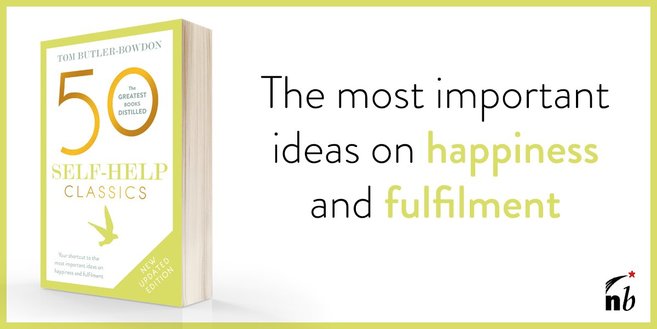
Source: 50 Self-Help Classics: Your shortcut to the most important ideas on happiness and fulfilment by Tom Butler-Bowdon (London & Boston: Nicholas Brealey)
Click to see reader views or to buy