As A Man Thinketh
(1902)
James Allen
In its theme that ‘mind is the master weaver’, creating our inner character and outer circumstances, As A Man Thinketh is an in-depth exploration of the central idea of self-empowerment writing.
James Allen's contribution was to take an assumption we all share - that because we are not robots we therefore control our thoughts - and reveal its fallacy. Because most of us believe that mind is separate from matter, we think that thoughts can be hidden and made powerless - this allows us to think one way and act another. But Allen believed that the unconscious mind generates as much action as the conscious mind, and while we may be able to sustain the illusion of control through the conscious mind alone, in actuality we are continually faced with a question, 'Why cannot I make myself do this or achieve that?' In noting that desire and will are sabotaged by the presence of thoughts that do not accord with the desire, Allen was led to the startling conclusion that, 'We do not attract what we want, but what we are.' Achievement happens because you as a person embody the external achievement; you don't 'get' success but become it. There is no gap between mind and matter.
We are the sum of our thoughts
The logic of the book is unassailable: noble thoughts make a noble person, negative thoughts hammer out a miserable one. To a person mired in negativity, the world looks as if it is made of confusion and fear. On the other hand, Allen noted, when we curtail our negative and destructive thoughts, ‘All the world softens towards us, and is ready to help us.’ We attract not only what we love - but what we fear. His explanation for why this happens is simple: those thoughts which receive our attention, good or bad, go into the unconscious to become the fuel for later events in the real world. As Emerson said, ‘A person is what he thinks about all day long.’
Our circumstances are us
Part of the fame of this book is its contention that ‘Circumstances do not make a person, they reveal him.’ This seems an exceedingly heartless comment, a justification for neglect of those in need and a rationalisation of exploitation and abuse; of the superiority of those at the top of the pile, and the inferiority of those at the bottom. This, however, would be a knee-jerk reaction to an argument of subtlety. While Allen does not deny that poverty can ‘happen’ to a person or a people, what he tries to make clear is that defensive actions like blaming the perpetrator will only further run the wheels into the rut. What measures us, what reveals us, is how we use those circumstances as an aid or spur to progress. A successful person or community, in short, is that which can process failure with the most efficiency.
Each set of circumstances, however bad, offers a unique opportunity for growth. If circumstances always determined the life and prospects of people, then humanity would never have progressed. In actuality, circumstances seem to be designed to bring out the best in us, and if we make the decision that we have been 'wronged' then we are unlikely to begin a conscious effort to escape from our situation. It all seems too hopeless. But as any biographer knows, a person's early life and its conditions are often the greatest gift to an individual. Gold does not emerge from jewellers' shops but from mud and rock.
One self-help author influenced by Allen is Wayne Dyer. Dyer observed that '...being broke is a temporary state of affairs that afflicts almost everyone at one time or another, but being poor is an attitude, a set of beliefs that gets reinforced when we shift to blaming life circumstances for the condition of our poverty'. The tragedy of poverty is that children born into it begin to accept it as part of their culture. Allen talks about those who feel that it is all right to do shoddy work because they are being paid so little. Yet this attitude - superficially justifiable - keeps them in the very situation they despise.
Tranquility = success
The influence of Buddhism on Allen's thought is obvious in the emphasis on 'right thinking', but it is also apparent in his suggestion that the best path to success is calmness of mind. People who are calm, relaxed and purposeful appear to look like that is their natural state, but nearly always it is the fruit of self-control. These people have an advanced knowledge of how thought works, coming from years of literally 'thinking about thought'. According to Allen, they have a magnet-like attraction because they are not swept up by every little wind of happenstance. We turn to them because they are masters of themselves. 'Tempest-tossed' souls battle to get success, but success avoids the unstable.
Final word
Almost a hundred years after publication, As A Man Thinketh continues to get rave reviews from readers. The plain prose and absence of hype are appealing within a genre that contains sensational claims and personalities, and the fact that we know so little about Allen makes the work somehow more intriguing.
The book's title comes from the Bible - 'As a man thinketh, so he is' - but despite this provenance, As A Man Thinketh is religion-neutral. Allen believed that the dynamic that linked thought to action and outer circumstances was a metaphysical law that could not err. In the way it identifies universal laws and applies them to the mechanics of desire and prosperity, the book is appropriately the 20th century's first self-help classic.
To bring its message to a wider audience, two updated versions of the work which right the gender-specificity of the original have been published: As You Thinketh, edited by Marc Allen (no relation) and As a Woman Thinketh, Dorothy Hulst.
(1902)
James Allen
In its theme that ‘mind is the master weaver’, creating our inner character and outer circumstances, As A Man Thinketh is an in-depth exploration of the central idea of self-empowerment writing.
James Allen's contribution was to take an assumption we all share - that because we are not robots we therefore control our thoughts - and reveal its fallacy. Because most of us believe that mind is separate from matter, we think that thoughts can be hidden and made powerless - this allows us to think one way and act another. But Allen believed that the unconscious mind generates as much action as the conscious mind, and while we may be able to sustain the illusion of control through the conscious mind alone, in actuality we are continually faced with a question, 'Why cannot I make myself do this or achieve that?' In noting that desire and will are sabotaged by the presence of thoughts that do not accord with the desire, Allen was led to the startling conclusion that, 'We do not attract what we want, but what we are.' Achievement happens because you as a person embody the external achievement; you don't 'get' success but become it. There is no gap between mind and matter.
We are the sum of our thoughts
The logic of the book is unassailable: noble thoughts make a noble person, negative thoughts hammer out a miserable one. To a person mired in negativity, the world looks as if it is made of confusion and fear. On the other hand, Allen noted, when we curtail our negative and destructive thoughts, ‘All the world softens towards us, and is ready to help us.’ We attract not only what we love - but what we fear. His explanation for why this happens is simple: those thoughts which receive our attention, good or bad, go into the unconscious to become the fuel for later events in the real world. As Emerson said, ‘A person is what he thinks about all day long.’
Our circumstances are us
Part of the fame of this book is its contention that ‘Circumstances do not make a person, they reveal him.’ This seems an exceedingly heartless comment, a justification for neglect of those in need and a rationalisation of exploitation and abuse; of the superiority of those at the top of the pile, and the inferiority of those at the bottom. This, however, would be a knee-jerk reaction to an argument of subtlety. While Allen does not deny that poverty can ‘happen’ to a person or a people, what he tries to make clear is that defensive actions like blaming the perpetrator will only further run the wheels into the rut. What measures us, what reveals us, is how we use those circumstances as an aid or spur to progress. A successful person or community, in short, is that which can process failure with the most efficiency.
Each set of circumstances, however bad, offers a unique opportunity for growth. If circumstances always determined the life and prospects of people, then humanity would never have progressed. In actuality, circumstances seem to be designed to bring out the best in us, and if we make the decision that we have been 'wronged' then we are unlikely to begin a conscious effort to escape from our situation. It all seems too hopeless. But as any biographer knows, a person's early life and its conditions are often the greatest gift to an individual. Gold does not emerge from jewellers' shops but from mud and rock.
One self-help author influenced by Allen is Wayne Dyer. Dyer observed that '...being broke is a temporary state of affairs that afflicts almost everyone at one time or another, but being poor is an attitude, a set of beliefs that gets reinforced when we shift to blaming life circumstances for the condition of our poverty'. The tragedy of poverty is that children born into it begin to accept it as part of their culture. Allen talks about those who feel that it is all right to do shoddy work because they are being paid so little. Yet this attitude - superficially justifiable - keeps them in the very situation they despise.
Tranquility = success
The influence of Buddhism on Allen's thought is obvious in the emphasis on 'right thinking', but it is also apparent in his suggestion that the best path to success is calmness of mind. People who are calm, relaxed and purposeful appear to look like that is their natural state, but nearly always it is the fruit of self-control. These people have an advanced knowledge of how thought works, coming from years of literally 'thinking about thought'. According to Allen, they have a magnet-like attraction because they are not swept up by every little wind of happenstance. We turn to them because they are masters of themselves. 'Tempest-tossed' souls battle to get success, but success avoids the unstable.
Final word
Almost a hundred years after publication, As A Man Thinketh continues to get rave reviews from readers. The plain prose and absence of hype are appealing within a genre that contains sensational claims and personalities, and the fact that we know so little about Allen makes the work somehow more intriguing.
The book's title comes from the Bible - 'As a man thinketh, so he is' - but despite this provenance, As A Man Thinketh is religion-neutral. Allen believed that the dynamic that linked thought to action and outer circumstances was a metaphysical law that could not err. In the way it identifies universal laws and applies them to the mechanics of desire and prosperity, the book is appropriately the 20th century's first self-help classic.
To bring its message to a wider audience, two updated versions of the work which right the gender-specificity of the original have been published: As You Thinketh, edited by Marc Allen (no relation) and As a Woman Thinketh, Dorothy Hulst.
Source: 50 Self-Help Classics: Your shortcut to the most important ideas on happiness and fulfilment by Tom Butler-Bowdon (London & Boston: Nicholas Brealey)
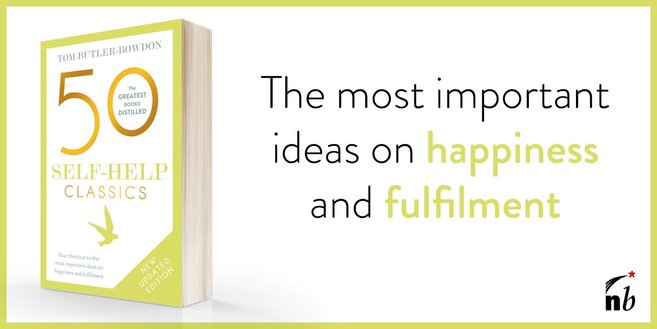
Click to see reader views or to buy