|
My Life and Work
(1922) Henry Ford My Life and Work takes you inside the mind of a person who managed to change the world, yet who lived in obscurity for the first 40 years of his life. This was a long time to develop skills, both personal and mechanical, which laid the foundation for a massive enterprise. Ford was that rare person, an inventor who went on to mass-produce his own invention. If you ever feel disheartened because you have an idea for a product or service that you have been told there is no market for, remember Ford's comment that 'there never is for new articles'. He saw fear as being the result of dependence on other people and circumstances, and in every area of his life, from the avoidance of debt to the work ethic that he held sacred, Ford was an expression of what Emerson called 'self-reliance'. The vision Described by his mother as a born mechanic, the greatest moment in Ford's childhood was seeing a 'road engine', a steam vehicle used to haul farm machinery. It was the first vehicle he had seen not being pulled by horses. Always tinkering, by age 15 he could fix almost any watch, and seriously considered becoming a watch manufacturer. But the idea of the 'horseless carriage' was too great and, without the support of his father, began to build one in the workshop he had built on the family farm. At 17 he began work as an apprentice machinist, qualifying before time, and rose through the ranks. In his spare time he worked on a gasoline engine and dreamed of building a 'universal car' that could transport people cheaply and reliably. In his 20s he was inspired by a brief meeting with the inventor Thomas Edison; despite virtually everyone at the time saying electricity was the future, Edison told him to stick at his engine. Ford's employer offered him a major promotion on condition he gave up his private obsession. His reaction? "I had to choose between my job and my automobile. I chose the automobile, or rather I gave up the job - there was really nothing in the way of choice. For already I knew that the car was bound to be a success. I quit my job on August 15, 1899, and went into the automobile business." ...and the reality Without personal funds, Ford had joined up with a group of investors to form the Detroit Automobile Company. He quickly found that they were more interested in quick profits than engineering a better machine, and after only a year and 20 cars, resigned. Four years later, the 40-year-old began the Ford Motor Company. It was capitalized at $100,000, and this time Ford owned a quarter of the stock. Over 1700 cars were built in the first year of operation, and the 'Model A' gained a reputation for reliability. The second year, giving into pressure from business associates, Ford brought out three models and raised prices. They sold fewer vehicles. He realized he had to have ownership in order to have full control, and using income generated from sales, brought his holdings up over 50%, later increased to 100%. In 1908-09 the firm sold over 10,000 cars, and again there was pressure to 'expand the range'. Ford went in exactly the opposite direction. One morning in 1909 he announced that Ford would now sell only one model: the Model T. What's more, it would be available in only one colour. "Any customer can have a car painted any colour that he wants so long as it is black", were his now famous words. Success While many believed the car's low price would bring the firm's collapse, Ford himself expected the market to dramatically expand. It did. He started building the largest factory in the world, Highland Park, and production capacity leaped from 6,000 to 35,000, while the number of staff merely doubled. By the early 1920s the company employed 50,000 and was turning out 4,000 cars a day. In 1921 alone, five million cars were produced. By the end of the decade, 15 million Model T's would be run off the assembly line. This was the miracle of mass production. It was price, though, that really made the Model T universal. In 1909-10 it had cost $950. Ten years later, it was selling for $355. How was this possible? Ford abhorred the idea of trying to get the highest price for the car. Instead, his strategy was to base prices on the cost of manufacture. If his factories could be made more and more efficient, the consumer would win. Like Sam Walton with his Wal-Mart stores, Ford discovered that he could make more profits from selling greater numbers of the product at a lower price, than selling fewer at a higher price. If you could manage to sell a high quality product cheaply via low cost methods, ".you will be meeting a demand which is so large that it may be called universal", Ford wrote. His early experience with investors demonstrated that the principle of 'return on the dollar' often sabotaged the creation of an enterprise that would grow into something substantial. Businesses were not cash cows; they should offer something that made lives better, and if they achieved this, good returns would naturally flow. Work and wages As American's assembly lines grew, the prevailing wisdom was that repetitive work numbed the body and spirit. Earning a way-above average $6 a day, Ford workers were less concerned. Ford believed that high wages increased the stability of the workforce and helped the men to concentrate, knowing that their families were taken care of. It also allowed them to be consumers, not just for Ford cars but for other goods and services which kept the economy buoyant. Ford's hiring methods were unusual. Of prospective workers, the firm wanted to know little more than their name, age, marital status and whether they were willing to work. Not speaking English and having a criminal record were not a problem. He did not hire 'experts' because they usually only knew what could not be done; he preferred 'fools who would rush in' to tackle problems with an open mind. Blind people, deaf and dumb people, men with only one leg or arm - all were employed by Ford at the same wage of the able-bodied. He wrote: "I think that if an industrial institution is to fill its whole role, it ought to be possible for a cross-section of its employees to show about the same proportions as a cross-section of a society in general. We always have with us the maimed and the halt." Such enlightened philosophy is taken for granted now, but it wasn't in the 1920s. The ideal of service In the early days of the car industry, Ford points out, there was no 'after sales service'. Car makers were totally focused on the selling rather than building a relationship with customers, and it was considered 'good business' to charge a lot for spare parts because the owner had no choice but to buy them. Ford believed that the sale of a car was just the beginning of a relationship with a buyer. He built his cars to last, but also made sure parts were transferable across models, cheap, and easy to install. This ideal of service might have seemed crazy to other manufacturers, but the trust it built up among the public was priceless. Ford's time was strangely similar to the dot.com bubble of recent years. He observed that: "A good business was not one that did good work and earned a fair profit. A good business was one that would give the opportunity for the floating of a large amount of stocks and bonds at high prices." His early experience with investors demonstrated that the principle of 'return on the dollar' often sabotaged the creation of an enterprise that would grow into something substantial. Businesses were not cash cows; they should offer something that made lives better, and if they achieved this, good returns would naturally flow. Final word A major figure of the 20th century, Ford combined two traits often seen in the super-successful person: an original, far-reaching vision that carries with it the potential to change the world; and an obsessive attention to detail that can drive other people mad. Ford's dark side included spying on managers, and belief in conspiracy theories about Jewish bankers taking over America. He has also been ridiculed for the famous saying that 'history is bunk'. This was his shorthand for the belief that education should not be about remembering facts, but teaching people how to think better. Despite how well he paid, Ford could not help noticing that most people chose jobs which enabled them not to have to think, while his admiration of Edison was based on the inventor's ability to 'think things through'. His achievements are of course inspiring, but what is the message Ford meant us to take from My Life And Work? Some comments late in the book about the concept of 'use' perhaps provide the key. He counsels against worrying too much about savings and investments as we normally think of them. He says: "You are not 'saving' when you prevent yourself from becoming more productive. You are really taking away from your ultimate capital; you are taking away the value of one of nature's investments." He is talking about YOU. Refining your ability to think, investing in yourself, should be your investment priority; it always provides the best returns. Download full text of My Life and Work from Project Gutenberg. |
"From the beginning I could never work up much interest in the labour of farming. I wanted to have something to do with machinery. My father was not entirely in sympathy with my bent toward mechanics. He thought I ought to be a farmer. When I left school at seventeen and became an apprentice in the machine shop of the Drydock Engine Works I was all but given up for lost." |
Source: 50 Success Classics: Your Shortcut to the Most Important Ideas on Motivation, Achievement, and Prosperity (published by Nicholas Brealey/Hachette, London & Boston).
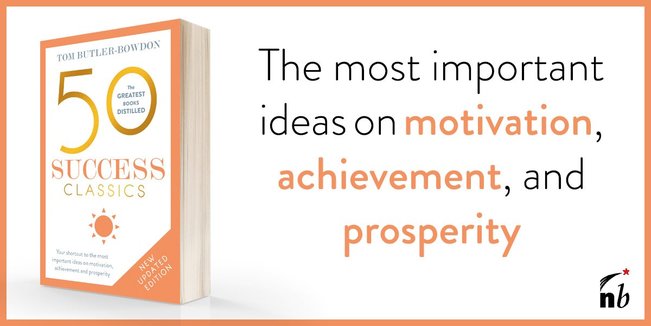
Click for reader reviews